Cryogenic treatment services. Make your parts last longer.
Deep Cryogenics International (DCI) performs deep cryogenic treatment in the USA for the mining, tool and die, and construction industries: a one-time −300 °F process with documented wear-life improvement of 20–60% against the customer's own baseline, about one week door to door, priced by weight, geometry, and material — with shipping, freight, and logistics handled by DCI.
What can you send us?
If it's a hardened, high-carbon, white iron or manganese steel part whose failure mode is wear, it's a candidate. The strongest documented results, by part family and wear mode:
| Part family | Published results | Wear mode addressed | Typical materials |
|---|---|---|---|
| Cone crusher mantles & concaves, jaw dies, crusher wear parts | 20–30% (gold mine, 2024) | High-stress & gouging abrasion, impact | 13–22% austenitic manganese steel, high-chrome white iron |
| Shovel & bucket teeth, adapters, GET | >90% best case · 30–40% mining results | Gouging abrasion, impact | Manganese & alloy steel castings |
| Slurry, paste & cyclone pump casings, impellers | 20–30% | Slurry erosion, abrasion | High-chrome white iron |
| Gears & drivetrain components | Improved wear & fatigue life in lab tests on carburized gear steels; no published % (published industry studies, 2007) | Contact fatigue, adhesive wear | Carburized & hardened alloy steels |
| Dies, punches & machine tooling | 40–100%+ tool life on gear-cutting hobs, cutters & inserts (published industry case studies, 2007) | Adhesive & abrasive wear, chipping | Tool steels |
How does the service work?
Four steps: quote, ship us parts, DCI treats them with a 72-hour computer-controlled cycle at −300 °F, parts are returned seven days later.
Quote
Send part type, alloy if known, and rough weight or quantity. Pricing is based on weight, part geometry, and material. Quotes returned within two business days.
Ship — we can arrange it
Shipping, freight, and logistics handled by DCI, both directions. Mine-site and marshaling-yard pickups are routine.
Treat & record
One continuous ~72-hour cycle: controlled descent, an extended soak at −300 °F, and an in-chamber temper to +200 °F. Every job carries its unbroken temperature record.
Verify & return
Hardness and XRD retained-austenite checks in our lab on request, then parts return to you — same dimensions, same fit.
How big can you go?
Up to 45,000 lb (20,400 kg) in a single load — the largest deep cryogenic treatment chamber in the world, 9.5′ × 7′ × 18.5′ — and up to 120,000 lb (54,431 kg) per month as a standing monthly service. Our first U.S. mining order totaled 48,000 lb.
Smaller orders may be batched with other scheduled jobs. No part is too small to quote or process.
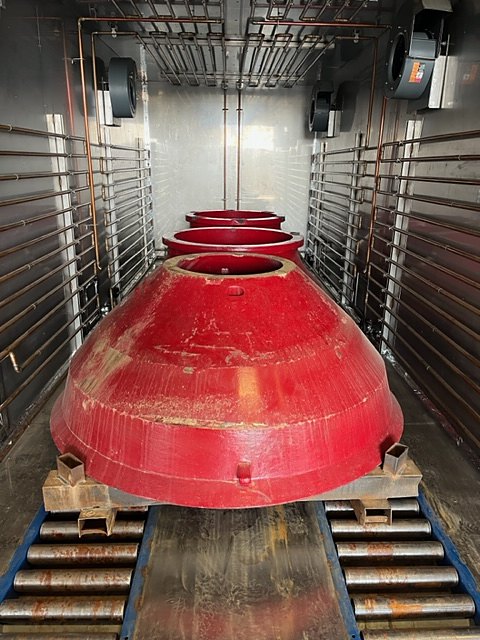
Why do reliability and maintenance teams specify DCT?
Because it lengthens the interval without touching anything else: no change to the OEM part, the work package, the install procedure, or the shutdown scope — and it stacks with the heat-treat spec you already buy.
Through the whole section
DCT changes the microstructure through the entire cross-sectional area — not a coating that wears off. Its effect lasts the life of the part: a treated liner is still a treated liner at its last inspection, and reground tooling is still treated tooling.
Same part, same spec, same work order
No new supplier, no design revision, no new procedure for the crew. Treated spares drop into the same install on the same PM date; in a trial, the only additions to the work package are a tag and a position map, plus the wear measurements you'd take at inspection anyway.
After heat treat, not instead of it
DCT runs downstream of conventional heat treating and complements it — a finishing step on a part already made to spec, reaching through the full cross-section rather than the surface alone.
Quotes in two business days · (720) 347-8886 · how pricing works