Cryogenic treatment of mining wear parts
DCI deep-cryogenically treats the mining industry's fastest-wearing consumables — cone crusher mantles and liners, jaw crusher plates, shovel and bucket teeth (GET), slurry and paste pump castings — at −300 °F. Published results run 20–60% longer wear life against the operation's own baseline, with a best documented case above 90%.
Three readers, one interval
A longer changeout interval is the whole product. Operations leadership sees it as unit cost and availability; the reliability team sees a defect eliminated and a PM calendar that holds; the plant metallurgist wants to know what changed in the casting and how it was measured. Each block below is written for one of you.
Consumables cost per ton, down. Capital, none.
Treated castings cost more per unit and less per ton processed, because they stay in service longer. It's an OPEX consumables line, not a sustaining-capital project: no new equipment, no plant change, no new OEM. Fewer relines and out-of-cycle changeouts a year, and fewer of the high-risk maintenance exposure hours your safety report counts — plus shutdown hours, where the changeout sits on the critical path.
Run it as a life-extension trial
Same OEM castings, same install, no change to the shutdown scope. Treated and control parts from the same heat lot go in alternating positions; wear is logged the way your CMMS already logs it — hours or tons to changeout, wear rate at each inspection. Fail criteria are agreed before anything ships. The protocol →
Mechanism scoped by alloy; XRD where it applies
In hardened alloy steel: retained-austenite conversion and fine carbide precipitation, quantified by X-ray diffraction before and after. In austenitic Hadfield manganese steel, the martensite story does not apply — the evidence there is field wear data. In high-chrome white iron, DCT works largely through precipitation of chromium carbides in the matrix, a reduction in retained austenite, and suppressed micro-crack nucleation at carbide boundaries. Read that section first →
What does the published data show?
| Result | Parts | Source & date |
|---|---|---|
| >90% wear life | Shovel teeth — 634 h avg vs 280–340 h baseline | Coeur Mining validation, Sept 2025 — case study |
| 30–40% | Ground-engagement tools across mining conditions | GET study, Jan 2025 |
| 20–30% | Cone crusher applications, at ~10% of part cost | Gold mine study, June 2024 |
| 26–34% | Large bucket teeth, two GET manufacturers — 163 h → 219 h and 280.5 h → 354 h to changeout; wear rate 0.065 → 0.045 in/hr; ±5% ground-condition variability disclosed; 3 and 2 replicate sets | Induspec Engineering study with a confidential mine, published in The Monty, 2022 |
Which mining parts respond?
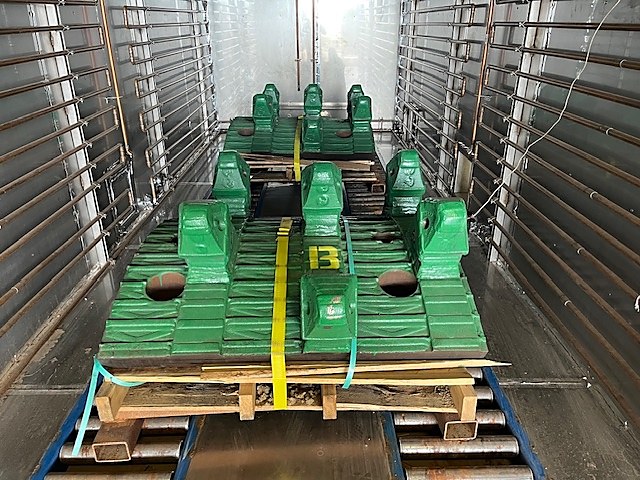
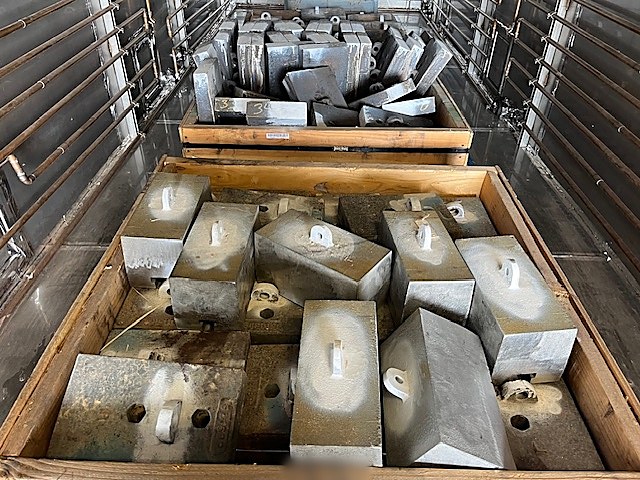
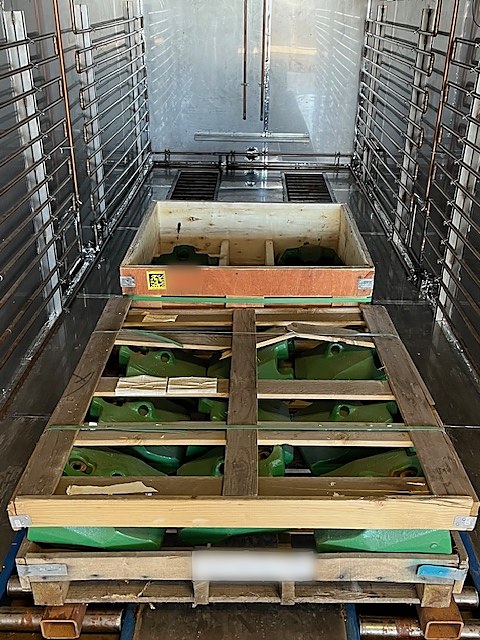
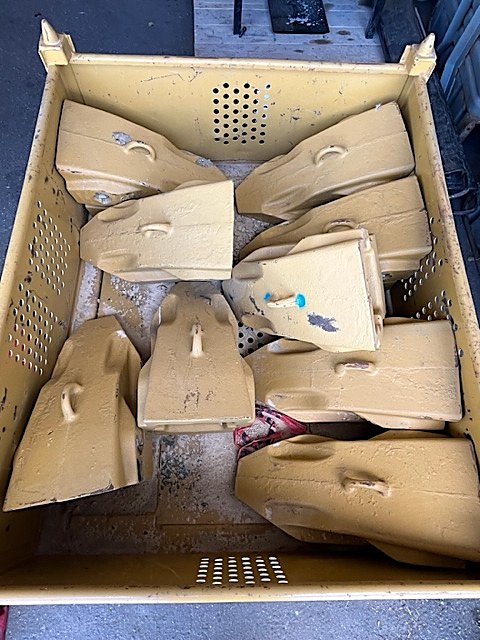
Mining wear consumables are generally castings in 13–22% austenitic manganese steel, high-chrome white iron, or high-carbon alloy steel — three of DCI's extensively researched alloy classes. The failure mode is almost always high-stress or gouging abrasion, with impact. We treat:
- Cone crusher mantles & concaves (bowl liners), jaw dies, crusher wear parts — manganese steel
- Shovel & bucket teeth, adapters, lips, crawler shoes — manganese & alloy steel castings
- Ground-engaging tools, drill bits, augers, asphalt milling teeth
- Slurry, paste & cyclone pump casings and impellers — high-chrome white iron
- Feeder pans, grinding media (SAG balls), gears
Why does DCT work on manganese steel?
Not by the textbook cryogenic mechanism. Hadfield-type manganese steel (13–22% Mn) is austenitic by design and work-hardens in service, so the retained-austenite-to-martensite conversion that drives DCT in hardened steels is not the story here. What DCI has is an empirical program, not a borrowed theory: treated and untreated Hadfield castings compared under an NRC-IRAP project with Innotech Alberta, and TRIP/TWIP work-hardening studied with the University of Alberta, with SEM/EBSD analysis under an NSBI grant — with improved wear resistance measured in treated castings — and the field results above as the operating evidence. The mechanism argument now has a reviewed home too: Twinning-assisted toughening of high-manganese steels after deep cryogenic treatment (Hajipour, Tian, Sun, Cahn, Li — Metallurgical and Materials Transactions A, 2026). What we sell on manganese steel is still the measured field result; the paper is where the explanation is being argued properly.
We say this plainly because a plant metallurgist will ask, and because manganese castings are most of a mine's crusher and GET spend. If your metallurgist wants the micrographs, hardness traverses, and a phase check confirming the casting is still austenitic after the soak, that conversation is welcome before a trial — it's what the lab is for, and the research reports can be shared. The mechanism, by alloy class →
How does treatment fit the maintenance plan and shutdown calendar?
As a standing monthly flow that never touches the shutdown scope: a container of spares ships on schedule, treated inventory sits in the yard ahead of the next planned changeout, installation is unchanged, and the freight is DCI's job — not the planner's.
Up to 120,000 lb/month
DCT offered as a standing monthly service for mine sites — a container of consumables ships on schedule, and treated inventory stays a changeout ahead of the PM calendar. That does mean holding one treated set ahead of the schedule, a working-capital point worth naming up front.
Ship to us from site or drop ship from your supplier
DCI can handle freight and shipping and work with your OEM/suppliers to shorten your logistics tail and ease your pain.
In your units, in your CMMS
Hours or tons to changeout against your standing baseline, wear rate at each inspection, plus lab verification on request — hardness, and XRD where the alloy calls for it — delivered as numbers you can attach to a work order or an RCA. Cost-per-ton math →
How do we run a trial you can defend?
With a written protocol before parts ship, so the result survives the meeting where someone asks "what else changed?" Treated and untreated parts come from the same heat or OEM lot, run in the same machine in alternating positions, and are measured the same way at the same interval. Fail criteria are agreed up front. Results come back in your units.
| Control set | Untreated parts from the same heat / OEM lot, installed alongside the treated set |
| Placement | Same crusher, bucket, or pump; alternating, position-matched pairs — corner teeth wear faster than center teeth, so treated and untreated teeth share positions across sets |
| One-piece liners | Mantles and concave tiers can't alternate, so the design is sequential: treated and untreated liner sets over consecutive lives, normalized by tons through the crusher, with feed abrasion index and closed-side setting logged per liner; plan at least three liner lives |
| Measurement | What you already record — operating hours (defined once, up front: engine, dig, or SMU hours) or tons to changeout; wear depth, weight loss, or 3D liner scan at each scheduled inspection |
| Replicates & duration | At least one full service life per set; for GET, three or more replicate sets. The Induspec study disclosed 3 and 2 sets and ±5% ground-condition noise — that disclosure is why it's credible |
| Confounders logged | Ore or ground conditions, closed-side-setting changes, feed changes, operator changes — noted as they happen, not argued about afterward |
| Fail criteria | Agreed in writing before shipping: the result that means "stop" — for example, treated mean life across three sets below baseline plus an agreed margin — so nobody has to be the one to say it |
| Traceability | Treated parts identified before they leave Longmont and matched to their cycle record, so treated and control sets stay separable in the yard and in your CMMS |
| Deliverable | Hours-to-changeout, wear rate, and a cost-per-ton or life-cycle-cost sheet with every assumption exposed — ready to attach to a work order, an RCA, or a CI initiative |
| Paperwork | Vendor prequalification and onboarding documents for your procurement team, on request |
A treated set that was never going to improve becomes a story about the treatment "not working" when the real problem was part selection — so the screen comes first. Send the alloy, the failure mode, and your current hours-to-changeout, and we'll tell you whether a trial is worth a slot in your shutdown before you commit one to it.
And the same problem as on the cost page: the person who runs the trial is rarely the person who releases the shutdown slot. This one is written to be pasted into that request.
Quotes in two business days · (720) 347-8886, Mon–Fri 8–4 Mountain