Deep cryogenic treatment. Wear parts that last longer — measured, not promised.
Deep Cryogenics International treats mining, tool and die, and construction wear parts at −220° to −300 °F, depending on alloy and failure mode. Documented wear-life gains run 20–60% against the customer's own baseline — best case to-date, shovel teeth at 634 hours against a 280–340 hour baseline. Same castings, same fit, about a week door to door, verified in our materials lab.
Longer wear life — in the way your parts are measured
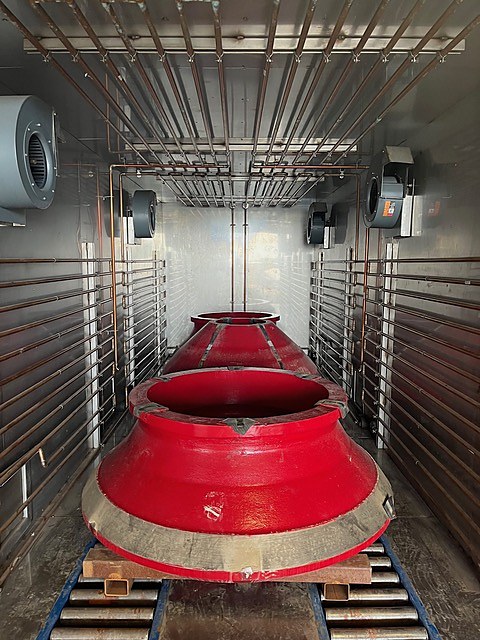
Deep cryogenic treatment is a one-time process applied to finished castings before they enter service. Nothing about the part, the install, or the supplier changes. What changes is the interval between changeouts — and every function at a mine sees that interval through a different number.
Lower consumables cost per ton, on OPEX
Treatment is a line item on castings you already buy — no capital, no new vendor, no change to the plant. Longer intervals mean fewer relines and out-of-cycle changeouts a year — and fewer hours of high-risk work for the crew; where the changeout sits on the critical path, shutdown hours come back too. The unit-cost math →
A life-extension trial against your baseline
Treated spares are staged ahead of the PM calendar and installed exactly as untreated ones. Wear is measured the way your CMMS already measures it — hours or tons to changeout, wear rate at each inspection — against a control set from the same lot. The trial protocol →
A through-material change, scoped by alloy
In hardened and carburized tool and gear steels, retained austenite converts to martensite plus fine carbide precipitation, verified by XRD. In austenitic manganese steel, the improvement mechanism is TRIP (Transformation Induced Plasticity) and TWIP (Twinning Induced Plasticity). In high-chrome white iron, DCT works largely through precipitation of chromium carbides in the matrix, a reduction in retained austenite, and suppressed micro-crack nucleation at carbide boundaries. See DCI's Mn research. What changes, by alloy →
>90% longer wear life on mining shovel teeth
Coeur Mining ran DCI-treated shovel teeth against their standing baseline of 280–340 operational hours. The treated teeth averaged 634 hours — measured by the mine, on their equipment, in their ore. Published September 2025.
One continuous, recorded cycle
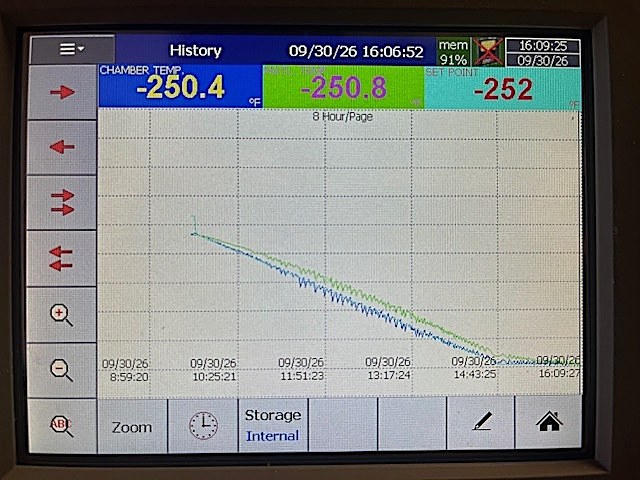
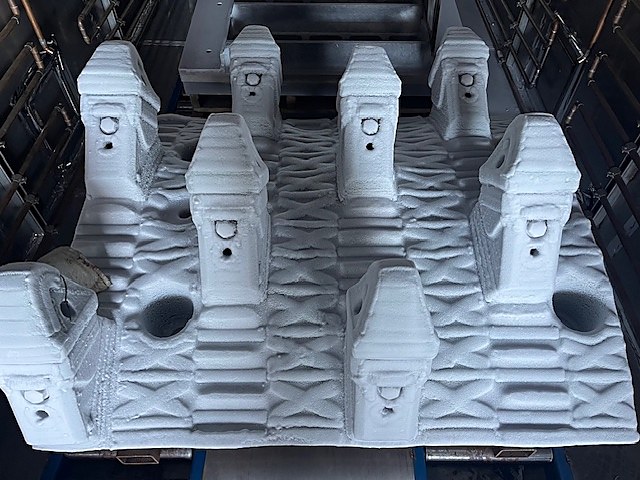
Liquid nitrogen is introduced through copper serpentine pipes, computer controlled — parts are surrounded by dry nitrogen vapor and never touch liquid. Full process explainer →
Ramp down cycle
Parts cool on a computer-controlled ramp in dry nitrogen vapor.
Deep soak
An extended hold at −220 to −300 °F. In hardened steels, retained austenite converts to martensite and fine carbides begin to form; each alloy class gets its own recipe.
In-chamber temper
The same chamber tempers up to +200 °F — one continuous run, one unbroken data record.
Built for the parts that wear out the fastest
Mining & aggregates
Shovel and bucket teeth and the rest of the GET string, cone crusher mantles and concaves, jaw dies, grinding media, slurry and paste pump castings, platens, slot nozzles — austenitic manganese, high-chrome white iron, and high-carbon alloy castings, treated whole. Cone crusher mantles and liners: 20–30% longer life.
Construction
Ground-engagement tools, asphalt milling teeth, drills, augers, and high-wear castings.
Tooling, gears & more
Dies and punch tooling, and gears with documented life gains.
Does cryogenic treatment actually work?
Yes, but only when the right recipe is matched to the correct alloy. Cryogenic treatment carries a "snake oil" history. We welcome your questions, and will answer them using material science and an engineering mindset: a named baseline, a control set, the customer's units, and scientific test instruments.
The evidence, including the limits
Published results from >90% to the honest 20–60% range — and the applications where DCT isn't worth it.
How we test
X-ray diffraction (XRD), white light interferometry, retained austenite instruments, and microscopy — the only research lab in the world dedicated exclusively to deep cryogenics.
Subject Matter Expert
Chief Technologist Jack Cahn writes the cryogenic treatment column in Cold Facts, the cryogenics physics journal. He has authored multiple US patents on process validation and testing, draft engineering standards for DCT, and co-authored two 2026 peer-reviewed deep cryogenic treatment studies.
We build the machines, too
Our cryogenic treatment service is fully operational using equipment that we design and manufacture. For shops that want to run cryogenic treatment in-house, we offer three DCT chamber models from 10,000 to 45,000 lb payload capacities, plus liquid nitrogen generators that produce up to 400 gallons/day, delivered turnkey with training.
Latest results & news
20–30% improvement on cone crusher mantles & liners
DCI can purchase entire container lots of shovel teeth, cone, and jaw crusher items for cryogenic treatment. A 12,000 lb forklift is on the floor for handling larger parts.
Cold Facts column #5: cryo in the heat-treat market
New opportunities for heat treaters adding cryogenic technology — the fifth feature column in the Cryogenic Society of America journal.
Cold Facts column #4: standards & certifications
Cryogenic testing, standards, and certification for deep cryogenic treatment.
Chief Technologist Jack Cahn returns quotes in two business days — how pricing works. Or call (720) 347-8886, Mon–Fri, 8–4 Mountain Time.